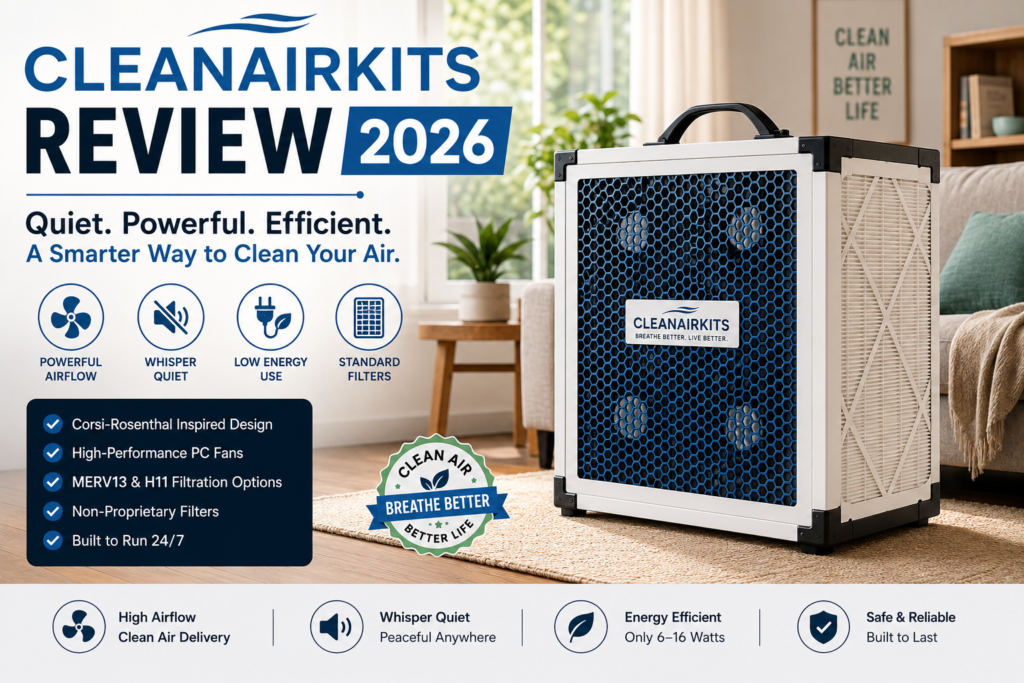
CleanAirKits Review 2026: Are These Quiet Air Purifiers Worth It?
Air purifiers often force you to make a compromise.
You can buy a powerful purifier capable of moving a lot of air, but it may become distracting when running at higher speeds. Or you can turn it down to make the room quieter, only to reduce the amount of air being cleaned.
CleanAirKits takes a very different approach.
Instead of relying on the traditional single-fan HEPA purifier design, CleanAirKits builds air cleaners inspired by the Corsi-Rosenthal Box, using banks of efficient PC fans combined with large-area filters.
The goal is simple: move a lot of clean air while keeping noise and electricity consumption low enough that the purifier can stay running throughout the day.
But does this unconventional design actually make sense for everyday homes, offices, classrooms, and bedrooms?
In this CleanAirKits Review 2026, we’ll examine how the technology works, the most popular CleanAirKits models, filtration performance, noise, energy efficiency, replacement filters, pricing, pros and cons, and whether CleanAirKits is worth buying.
Looking for a better price? Check our CleanAirKits Store page on Persiavo for current coupons, deals, and available promotions before ordering.
What Is CleanAirKits?
CleanAirKits is an air-cleaning company focused on improving the traditional Corsi-Rosenthal Box concept.
A classic Corsi-Rosenthal Box typically combines several furnace filters with a large box fan.
The design became popular because it can provide impressive clean-air delivery without requiring an expensive proprietary air purifier.
CleanAirKits takes that concept and makes it more practical for everyday spaces.
Instead of one large box fan, its designs use multiple high-static-pressure PC fans.
These are the same general type of fans developed for moving air through restrictive computer cooling systems.
Combined with large filter surfaces, this allows CleanAirKits to create air cleaners designed around three priorities:
- High airflow
- Low noise
- Low energy consumption
Another important difference is filter availability.
Many CleanAirKits models use commonly available furnace filters rather than proprietary replacement cartridges that can only be purchased from the purifier manufacturer.
That could make long-term ownership considerably more convenient.
How Does CleanAirKits Work?
The basic principle behind an air purifier is straightforward.
Contaminated room air passes through a filter, airborne particles become trapped, and cleaner air returns to the room.
What matters isn’t simply how efficient the filter is on a single pass.
The amount of air moving through the purifier also matters.
This is where CleanAirKits’ approach becomes interesting.
Rather than relying exclusively on an extremely restrictive filter and powerful motor, the company combines relatively large filter areas with multiple efficient fans.
The result is designed to provide substantial clean-air delivery without requiring a loud, power-hungry blower.
MERV13 vs HEPA: What’s the Difference?
One of the first things shoppers may notice is that several CleanAirKits products use MERV13 furnace filters rather than the traditional HEPA filters found in many commercial air purifiers.
HEPA filters are designed to capture a very high percentage of particles during each pass.
MERV13 filters have lower single-pass filtration efficiency.
However, air-cleaning performance isn’t determined by filtration percentage alone.
Airflow also matters.
If a purifier moves significantly more air through the filter, the same room air can pass through the filtration system repeatedly.
This is one of the fundamental ideas behind Corsi-Rosenthal-style air cleaners.
For buyers comparing products, Clean Air Delivery Rate (CADR) is therefore often more useful than simply asking whether a purifier uses HEPA.
What Does CleanAirKits Sell?
CleanAirKits offers several purifier designs intended for different room sizes and placement requirements.
Luggable Air Purifiers
The Luggable series is probably the product line most closely associated with CleanAirKits.
These units combine multiple PC fans with two large furnace filters in a relatively slim enclosure.
Depending on the configuration, they’re designed for spaces such as:
- Bedrooms
- Living rooms
- Family rooms
- Classrooms
- Offices
The integrated handle also makes them easier to move between rooms than a traditional DIY Corsi-Rosenthal cube.
Best for:
Everyday home and classroom air cleaning
Brisk Box
The Brisk Box is closer to the traditional Corsi-Rosenthal Box concept.
It uses multiple filters combined with banks of PC fans to generate higher airflow.
Some larger Brisk Box configurations are designed for spaces such as:
- Classrooms
- Workshops
- Gyms
- Large living areas
For example, the Brisk Box Ultra 8-fan model is rated by CleanAirKits at up to 441 CFM dust CADR, with approximately 16 watts of power consumption and a stated sound pressure of 48 dB.
Best for:
Larger rooms where maximum airflow matters
Exhalaron
The Exhalaron line is designed around a more compact form factor.
Instead of looking like a large floor-standing purifier, these units can fit more naturally on desks, tables, shelves, or other smaller spaces.
Some configurations also include adjustable fan speed.
That makes the Exhalaron particularly interesting for:
- Bedrooms
- Offices
- Conference rooms
- Travel
- Personal workspaces
Best for:
Compact spaces and desktop use
Aerating End Table
One of CleanAirKits’ more unusual products integrates air filtration into furniture.
The Aerating End Table is designed to function both as an end table and an air cleaner.
This helps address one of the biggest aesthetic problems with air purifiers: finding somewhere to put them.
Best for:
Living rooms and design-conscious homes
Why People Choose CleanAirKits
1. Very Quiet Operation
Noise is arguably CleanAirKits’ biggest selling point.
Air purifiers are most effective when they’re actually running.
Unfortunately, powerful traditional purifiers can become noisy enough that users lower the fan speed—or turn them off completely.
CleanAirKits attempts to solve this by spreading airflow across multiple quiet PC fans.
Instead of one large motor doing all the work, several smaller fans share the load.
For bedrooms, classrooms, conference rooms, and offices, this can be a meaningful advantage.
2. Excellent Energy Efficiency
PC fans have benefited from decades of optimization in the computer industry.
Manufacturers have spent years developing fans capable of moving substantial amounts of air while consuming relatively little electricity.
CleanAirKits takes advantage of that technology.
According to the company, many of its fan banks consume roughly 6–16 watts, depending on the model.
That’s remarkably low compared with many high-output conventional air purifiers.
For a device intended to run for many hours every day, energy efficiency matters.
3. Non-Proprietary Filters
This may actually be one of the most underrated advantages.
Many traditional air purifiers require replacement filters designed specifically for that model.
If the manufacturer raises prices, changes the product, or discontinues the purifier, finding replacements can become difficult.
Several CleanAirKits designs instead use standard furnace filters such as 3M Filtrete.
That means owners aren’t necessarily locked into buying filters directly from CleanAirKits.
Over several years of ownership, this could make replacement filters easier to source and potentially less expensive.
4. Designed to Run Continuously
CleanAirKits describes its philosophy as essentially “always-on” filtration.
Because the units are designed to remain relatively quiet and energy efficient, users can leave them operating without constantly adjusting fan speeds.
This makes sense from an air-cleaning perspective.
Continuous filtration helps reduce the concentration of airborne particles as they’re introduced into the room.
What Can CleanAirKits Filter?
Depending on the filter used, these systems are designed to help reduce airborne particulate matter such as:
- Dust
- Pollen
- Smoke particles
- PM2.5
- Mold-related airborne particles
- Respiratory aerosols
Like other particulate air cleaners, however, they shouldn’t be confused with complete indoor-air-quality systems.
Particle filtration doesn’t automatically solve problems involving high CO₂, excessive humidity, or every gaseous pollutant.
Good indoor air quality may still require proper ventilation and source control in addition to filtration.
CleanAirKits vs Traditional HEPA Purifiers
This is probably the most important comparison for potential buyers.
Traditional HEPA Purifier
Advantages
- Very high single-pass filtration efficiency
- Compact enclosed design
- Often includes automatic modes
- Some models include sensors and smartphone apps
Disadvantages
- Replacement filters may be proprietary
- High fan speeds can become noisy
- Higher-performance units may consume considerably more power
CleanAirKits
Advantages
- High airflow
- Very low energy consumption
- Quiet operation
- Large filtration area
- Standard replacement filters on many models
- Repairable/modular design
Disadvantages
- More utilitarian appearance
- Fewer smart features
- Some products require assembly
- MERV13 models don’t have the same single-pass efficiency as true HEPA filters
The better choice therefore depends on what you value.
If you want an app-controlled appliance with built-in sensors and polished consumer-electronics styling, a conventional purifier may be more appealing.
If your priorities are quiet airflow, efficiency, repairability, and inexpensive standardized filtration, CleanAirKits becomes much more interesting.
What About Noise?
This is where the PC-fan design has a genuine practical advantage.
PC enthusiasts have demanded quieter cooling fans for decades.
Modern premium PC fans are designed to minimize motor noise, vibration, and turbulence while maintaining useful static pressure.
CleanAirKits uses that technology to pull air through filters.
Some users in air-purifier communities specifically praise CleanAirKits for being quiet enough to leave running in bedrooms, living spaces, and offices.
For noise-sensitive users, that could be more important than having additional smart features.
Replacement Filters and Maintenance
Air purifiers aren’t one-time purchases.
Filters eventually need replacing.
CleanAirKits recommends replacement intervals that can vary depending on the model, filter type, and environment, with many configurations using filters for approximately 6–12 months.
Homes affected by wildfire smoke, pets, heavy dust, or other particulate pollution may require more frequent replacement.
Because many models use widely available furnace filters, owners can often shop around rather than being forced to buy replacements from a single manufacturer.
That’s a major advantage for long-term ownership.
Repairability
Another interesting part of the CleanAirKits philosophy is repairability.
PC fans are standardized components.
If a fan eventually fails, replacing one is much simpler than repairing the proprietary blower assembly found inside many consumer air purifiers.
CleanAirKits even offers replacement fan kits, while also noting that owners can source compatible PC fans elsewhere.
This is the kind of design decision we like to see in products intended for long-term use.
Customer Feedback
CleanAirKits has developed a particularly enthusiastic following among people interested in indoor air quality and Corsi-Rosenthal Box designs.
What Owners Like
Common positives include:
- Very quiet operation
- Low electricity consumption
- Strong airflow
- Standard replacement filters
- Lightweight designs
- Ability to run continuously
- Repairable components
The Luggable series receives particular praise from some owners for living spaces and bedrooms.
Common Complaints
CleanAirKits isn’t perfect.
Potential drawbacks mentioned by users include:
- Some models look more DIY than conventional premium air purifiers
- Certain configurations can be expensive upfront
- Some models require assembly
- Lightweight construction may feel less robust than molded commercial appliances
- Higher-CADR competitors may offer more raw airflow for the purchase price
This last point is particularly important.
CleanAirKits isn’t necessarily trying to win purely on maximum CADR per dollar.
Its stronger proposition is the combination of CADR + low noise + low power consumption + standard filters.
That distinction matters when comparing it with cheaper DIY CR boxes or high-output commercial purifiers.
Pros & Cons
Pros
✔ Exceptionally quiet design
✔ Very low electricity consumption
✔ Strong clean-air delivery
✔ Standard replacement filters on many models
✔ No proprietary-filter lock-in
✔ Multiple sizes for different rooms
✔ Repairable PC-fan architecture
✔ Suitable for continuous operation
✔ Interesting alternative to conventional HEPA purifiers
Cons
✘ Some designs have a DIY/utilitarian appearance
✘ Initial price can be higher than DIY CR boxes
✘ Some kits require assembly
✘ Fewer smart features than mainstream premium purifiers
✘ Not necessarily the highest raw CADR per dollar
Is CleanAirKits Worth the Money?
For the right buyer, yes.
CleanAirKits isn’t trying to compete by adding Wi-Fi, colorful displays, air-quality apps, or complicated automatic modes.
Instead, the company focuses on the fundamentals:
Move a lot of air through good filters, make as little noise as possible, and consume very little electricity while doing it.
That’s a compelling philosophy.
A cheaper purifier may initially look like better value, but long-term electricity consumption and proprietary replacement-filter costs should also be considered.
Likewise, an inexpensive DIY Corsi-Rosenthal Box can deliver excellent airflow, but it may be bulkier, louder, and less attractive in a living space.
CleanAirKits sits somewhere between those two worlds.
It offers much of the efficiency and simplicity of DIY air-cleaning designs while packaging the concept into products that are easier to use in everyday environments.
Who Should Buy CleanAirKits?
CleanAirKits is particularly attractive for:
- Noise-sensitive users
- Bedrooms
- Home offices
- Classrooms
- Shared workplaces
- Families wanting continuous filtration
- People concerned about wildfire smoke or PM2.5
- Buyers tired of expensive proprietary filters
- Corsi-Rosenthal Box enthusiasts wanting a more refined solution
Who Should Look Elsewhere?
You may prefer another purifier if:
- You want built-in air-quality sensors.
- Smartphone control is important to you.
- You prefer a highly polished appliance-style design.
- Your priority is simply the highest possible CADR for the lowest upfront price.
- You need specialized gas or odor filtration rather than primarily particulate filtration.
Frequently Asked Questions
Is CleanAirKits legit?
Yes. CleanAirKits produces commercialized versions of PC-fan Corsi-Rosenthal-style air cleaners and sells multiple models for homes, offices, classrooms, and other indoor spaces.
Does CleanAirKits use HEPA filters?
It depends on the model. Several CleanAirKits designs use MERV13 furnace filters, while some other models use EPA H11 filters.
Always check the filter specification for the specific model you’re considering.
Are MERV13 filters good enough for air purification?
MERV13 filters capture a substantial percentage of fine airborne particles. In Corsi-Rosenthal-style systems, large filter surface area and high airflow allow room air to pass through the filters repeatedly.
How often do CleanAirKits filters need replacing?
Replacement frequency depends on usage and indoor air conditions, but many configurations are designed around approximately 6–12 months between filter replacements.
Are CleanAirKits quiet?
Low noise is one of the company’s main design priorities. Multiple PC fans are used specifically to provide useful airflow while avoiding the high noise levels associated with many conventional purifiers operating at maximum speed.
Does CleanAirKits help with wildfire smoke?
Appropriately sized particulate filtration can help reduce airborne smoke particles and PM2.5 indoors. However, wildfire smoke can also contain gaseous pollutants that require different filtration approaches, so particulate filtration shouldn’t be considered a complete solution for every component of smoke.
Final Verdict
Overall Rating: ⭐⭐⭐⭐☆ (4.7/5)
| Category | Rating |
|---|---|
| Air Cleaning Performance | ⭐⭐⭐⭐⭐ |
| Noise Level | ⭐⭐⭐⭐⭐ |
| Energy Efficiency | ⭐⭐⭐⭐⭐ |
| Filter Availability | ⭐⭐⭐⭐⭐ |
| Design & Build | ⭐⭐⭐⭐☆ |
| Value for Money | ⭐⭐⭐⭐☆ |
| Features | ⭐⭐⭐⭐☆ |
| Overall Rating | ⭐⭐⭐⭐☆ 4.7/5 |
CleanAirKits offers one of the more interesting alternatives to conventional consumer air purifiers.
Rather than competing through apps, sensors, or proprietary technology, the company takes the proven Corsi-Rosenthal concept and improves some of its biggest practical weaknesses—particularly noise, energy consumption, size, and everyday usability.
The ability to use commonly available replacement filters is another significant advantage, especially when you consider the lifetime cost of owning an air purifier.
CleanAirKits won’t be perfect for everyone. Some buyers will prefer the polished design and smart features of traditional HEPA appliances, while DIY enthusiasts can build cheaper Corsi-Rosenthal Boxes themselves.
But for people who want quiet, efficient, continuously running particulate filtration without being locked into expensive proprietary filters, CleanAirKits is easy to recommend.
Where to Buy CleanAirKits
Looking for current promotions?
👉 Browse the CleanAirKits Store on Persiavo
Ready to buy?
👉 Visit the Official CleanAirKits Store
Checking the Persiavo store page first can help you find current CleanAirKits coupon codes or available promotions before ordering.
Make Smarter Buying Decisions
Get new reviews, product comparisons, brand discoveries, and practical shopping guides delivered to your inbox.
New Reviews
Shopping Guides
Brand Discoveries