
Hume Health Review 2026: How Accurate Are the Body Pod and Hume Band?

The wellness-tech market has no shortage of devices promising to help you understand your body better.
Smart scales estimate body fat and muscle mass. Wearables track sleep, heart rate, recovery, and activity. Apps then turn all of that data into scores, charts, and increasingly, AI-generated recommendations.
Hume Health attempts to bring these ideas together into one ecosystem.
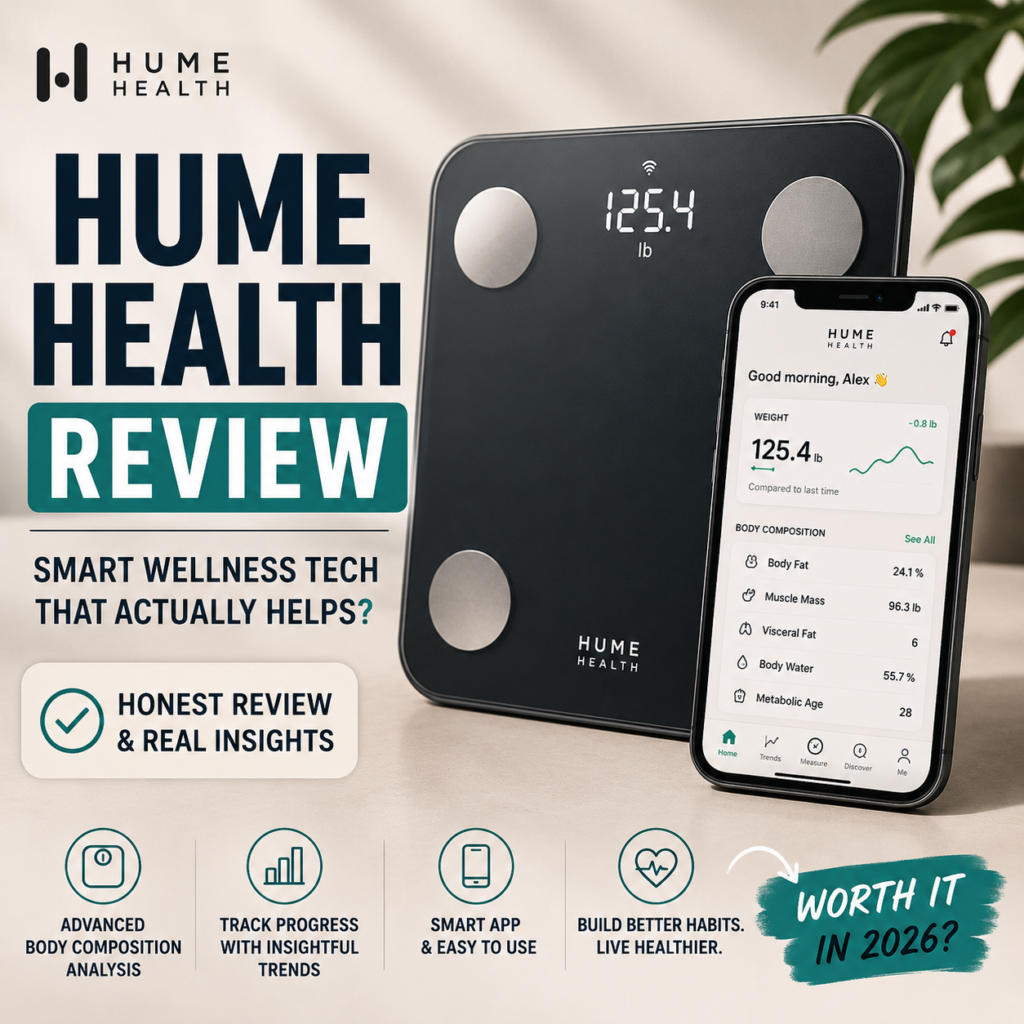
Its two most interesting products are the Hume Pod, a multi-frequency body-composition scale, and the Hume Band, a screenless wearable focused on sleep, recovery, activity, and longer-term wellness trends.
On paper, it’s an attractive combination.
The Pod tells you how your body is changing, while the Band attempts to explain how your daily behavior may be contributing to those changes.
But health technology deserves more scrutiny than the average consumer gadget.
How accurate is the Hume Pod compared with DXA? How useful are its dozens of body-composition metrics? Can you trust the Hume Band’s wellness data? And does Hume Health provide enough value to justify buying into the ecosystem?
In this Hume Health Review 2026, we’ll separate what is supported by evidence from what is primarily marketing, examine the Hume Pod and Hume Band individually, look at independent testing and customer feedback, and explain who we think should — and shouldn’t — buy them.
Quick Verdict
Persiavo Rating: 4.0/5
Hume Health is an interesting wellness ecosystem, but our opinion differs significantly between its two main products.
| Category | Our Assessment |
|---|---|
| Hume Pod | ⭐⭐⭐⭐½ Very Good |
| Hume Band | ⭐⭐⭐½☆ Promising, but less proven |
| Body Composition Tracking | ⭐⭐⭐⭐½ |
| App & Insights | ⭐⭐⭐⭐☆ |
| Fitness Tracking | ⭐⭐⭐½☆ |
| Ease of Use | ⭐⭐⭐⭐☆ |
| Value | ⭐⭐⭐⭐☆ |
| Customer Experience | ⭐⭐⭐½☆ |
| Overall | ⭐⭐⭐⭐☆ 4.0/5 |
The Hume Pod is the strongest reason to consider Hume Health.
Unlike many smart scales whose accuracy claims are difficult to evaluate, the Pod now has independent research suggesting strong repeatability and good agreement with laboratory body-composition methods, although it is not interchangeable with DXA.
The Hume Band is harder to recommend as confidently.
It provides useful wellness and recovery data without requiring a mandatory subscription for core metrics, but independent testing has identified weaknesses around fitness tracking and some measurements.
Our short version:
Buy the Hume Pod primarily for body-composition tracking.
Consider the Hume Band if you want a screenless wellness/recovery tracker, but don’t buy it expecting medical diagnostics or best-in-class sports tracking.
What Is Hume Health?
Hume Health is a consumer health-technology company focused on body composition, recovery, metabolic wellness, and longitudinal health tracking.
The ecosystem currently revolves primarily around:
- Hume Pod body-composition scale
- Hume Band wearable
- Hume Health mobile app
- Optional premium AI-driven coaching
The idea behind combining the products makes sense.
A wearable can collect information continuously about things such as sleep, heart rate, HRV, activity, and recovery.
A body-composition scale measures a different set of outcomes.
Together, they can potentially answer two separate questions:
What am I doing?
and
How is my body changing?
That distinction is more meaningful than simply putting more health metrics into one dashboard.
Hume Pod: The Strongest Product in the Ecosystem
The Hume Pod is a multi-frequency bioelectrical impedance analysis (BIA) scale.
Unlike an ordinary scale that measures only body weight, BIA devices send a very small electrical current through the body and use electrical impedance, along with algorithms and user characteristics, to estimate body composition.
Hume says the Pod provides 45 body-composition measurements.
Its official specifications include four weight sensors, dual-frequency body-fat measurement, a 5–200 kg measurement range, rechargeable battery, Bluetooth connectivity, and a 2.8-inch display. It can also integrate data from platforms including Apple, Fitbit and Garmin.
But the number of metrics isn’t what makes the Hume Pod interesting.
The important question is:
Are the estimates actually useful?
How Accurate Is the Hume Pod?
This is where the discussion gets considerably more interesting than it was even a few months ago.
Hume markets the Pod heavily around its accuracy and says contracted testing showed results close to DXA.
Manufacturer accuracy claims should always be treated cautiously.
Fortunately, independent researchers have now evaluated the Hume Pod against both DXA and a four-compartment (4C) body-composition model.
What the Independent Study Found
A 2026 study involving 67 adults compared duplicate Hume Pod measurements with DXA and a four-compartment reference model.
For test-retest reliability, the results were strong.
Intraclass correlation coefficients were at least 0.993, while technical error of measurement was approximately:
- 0.8% for body-fat percentage
- 0.6 kg for fat mass
- 0.6 kg for fat-free mass
Compared with the four-compartment model, body-fat percentage, fat mass, and fat-free mass showed strong agreement.
The results against DXA require more nuance.
Hume Pod body-fat percentage averaged 27.1%, versus 28.9% for DXA.
The correlation was very strong at r = 0.94, but the two methods were not statistically equivalent for body-fat percentage, and mean absolute error was approximately 3 percentage points.
That’s actually a fairly encouraging result for a consumer BIA device.
But it does not mean:
Hume Pod = DXA at home.
Correlation and equivalence aren’t the same thing.
Two devices can track people similarly while still producing meaningfully different absolute values for an individual.
There’s another caveat: the study is currently available as a medRxiv preprint, so it has not yet gone through the complete peer-review process associated with a final journal publication.
Our Interpretation
We think the fairest conclusion is:
The available evidence suggests Hume Pod is a relatively strong consumer body-composition analyzer, but its measurements should not be treated as interchangeable with DXA.
That’s considerably stronger than saying:
“It’s just useful for trends.”
But considerably more responsible than saying:
“It’s 98% as accurate as a DEXA scan.”
Why BIA Measurements Still Vary
Even a good BIA device is affected by measurement conditions.
Bioelectrical impedance depends partly on body water distribution.
Measurements can therefore change with:
- Hydration
- Food intake
- Exercise
- Alcohol
- Time of day
- Recent fluid intake
This doesn’t make BIA useless.
It means measurement protocol matters.
If you’re using the Hume Pod to track progress, try to measure yourself under similar conditions each time.
For example:
Morning → after using the bathroom → before breakfast → before exercise.
Consistency makes longitudinal data much more meaningful.
Don’t Obsess Over All 45 Metrics
Hume’s large number of reported measurements sounds impressive.
But more metrics don’t automatically mean more independent information.
Many consumer body-composition metrics are calculated or derived from the same underlying impedance and demographic inputs.
For most people, we think the most useful variables are simpler:
- Body weight
- Body-fat trend
- Fat mass
- Fat-free/lean mass
- Muscle-related trends
- Visceral-fat trend
These can help answer practical questions.
For example:
Am I losing weight primarily while maintaining lean mass?
or:
Is my weight staying similar while body composition changes?
That’s much more actionable than monitoring dozens of numbers simply because they’re available.
Hume Band: A Different Proposition
The Hume Band is a screenless wearable.
That’s important.
It isn’t trying to replace an Apple Watch or Garmin with notifications, apps, maps, and a display.
Instead, it competes more directly with the philosophy behind products such as WHOOP:
Wear it continuously, collect physiological data, then use the app to understand recovery and longer-term trends.
Hume lists sensors including five LEDs and four photodiodes.
Depending on the current Band version, tracked measurements and derived metrics can include:
- Heart rate
- Heart-rate variability (HRV)
- Blood oxygen
- Skin temperature
- Sleep stages
- Activity and movement
- Strain
- Recovery
The current Band 2.0 specification also advertises IP68 water resistance and battery life of up to 14 days.
What We Like About the Hume Band
Screenless Design
A screenless wearable makes sense for wellness tracking.
There’s no additional display demanding your attention throughout the day.
If your goal is data collection rather than smartwatch functionality, that’s arguably an advantage.
No Mandatory Subscription for Core Metrics
Hume provides access to core metrics through the free app and offers Premium separately for additional AI-driven coaching.
That’s attractive compared with wearables where the ongoing subscription is effectively part of the product cost.
Recovery-Focused Approach
HRV, resting heart rate, sleep, and other longitudinal measurements can be useful when interpreted as patterns rather than isolated numbers.
A recovery score isn’t a medical diagnosis.
But consistent changes in sleep, resting HR, HRV, and training load can help users understand how their routines affect them.
Where the Hume Band Needs More Caution
This is where our review becomes less enthusiastic.
Independent hands-on testing of Hume Band 2.0 found improvements such as longer battery life and a greater focus on wellness metrics, but also identified shortcomings in fitness tracking and overall accuracy.
Testing of the earlier Hume Band similarly described it as useful for long-term wellness monitoring but noted quirks, including real-world battery life falling below the advertised figure.
That means we wouldn’t currently choose Hume primarily as:
- A serious running watch
- A GPS sports watch
- A high-performance training platform
- A smartwatch replacement
Its strongest use case is general wellness and recovery tracking.
Be Careful With Health Claims
This point matters.
Hume’s marketing uses ambitious language around longevity, metabolic health, and identifying declining health patterns.
For example, its marketing describes using Band data to identify changes in recovery, stress, and sleep that may be associated with future illness.
Consumers should distinguish between:
measured signals
and
interpretations derived from those signals.
Heart rate is a physiological measurement.
HRV is a physiological measurement.
Skin temperature is a measurement.
A proprietary “Health Score,” “Metabolic Momentum,” or similar composite score is an algorithmic interpretation.
That doesn’t make the score useless.
But it shouldn’t be treated like a laboratory biomarker or medical diagnosis.
We would use these scores to ask:
“Has something changed in my routine or recovery?”
not:
“Do I have a disease?”
Hume Health App
The app is what connects the ecosystem.
Hume combines data from the Pod and Band and turns it into trends, scores, and wellness insights.
We like this concept because raw health data can become overwhelming very quickly.
A good health app should help users move from:
data → pattern → action
rather than simply displaying dozens of charts.
Hume provides its core app functionality without requiring the premium coaching subscription, while Premium adds AI-driven coaching and feedback.
Whether Premium is worth paying for is less clear.
One recent verified customer review specifically questioned how much additional value the AI subscription provided, despite being generally positive about the hardware ecosystem.
Our recommendation would be simple:
Use the free/core experience first.
Only pay for premium coaching if you find yourself consistently acting on the additional insights.
Hume Pod + Hume Band: Better Together?
Potentially, yes.
This is where Hume Health becomes more compelling than either device considered alone.
Think about it this way.
Hume Band Measures Inputs and Daily State
It helps monitor:
- Sleep
- Activity
- Heart rate
- HRV
- Recovery
- Physiological trends
Hume Pod Measures Body-Composition Outcomes
It helps estimate:
- Body fat
- Fat mass
- Lean mass
- Weight
- Other body-composition trends
That creates an interesting feedback loop.
Suppose you change your training and nutrition for three months.
The Band may help you see how your sleep, activity, and recovery are changing.
The Pod can help you see whether body composition is moving in the intended direction.
That’s more useful than collecting data without a specific question.
Hume Health vs DEXA
Hume Pod and DXA shouldn’t be viewed as direct substitutes.
DXA is a laboratory imaging method.
Hume Pod is an at-home BIA device.
DXA has advantages when you need a more established laboratory assessment at a specific point in time.
Hume Pod has a completely different advantage:
you can use it repeatedly at home.
Doing a DXA scan every morning would be impractical and unnecessary.
Stepping on a scale takes seconds.
That’s why the better comparison isn’t necessarily:
Which device is more accurate?
It’s:
Which tool is appropriate for what I’m trying to measure?
For repeated home monitoring, Hume Pod has a strong convenience advantage.
For clinical or research-grade assessment, use an appropriate validated clinical method.
Hume Health vs a Cheap Smart Scale
This is probably the more relevant purchasing question.
There are inexpensive BIA scales everywhere.
If all you want is:
weight + rough body-fat trend
a much cheaper smart scale may be sufficient.
Hume Pod makes more sense if you value:
- Multi-frequency BIA
- Segmental/more detailed body analysis
- Better-supported accuracy
- Integration with the Hume ecosystem
- More extensive body-composition reporting
- Combining scale and wearable data
The independent validation data strengthens Hume’s case here.
We wouldn’t pay the premium simply because it reports more metrics.
We would pay it if better body-composition assessment and ecosystem integration are genuinely useful to you.
What Do Customers Say?
Customer feedback is mixed enough that it shouldn’t be ignored.
At the time of our research, Hume Health’s Trustpilot profile had roughly 5,500 reviews and a score around 3.6/5.
There are plenty of positive experiences.
Recent reviewers praise:
- Body-composition insights
- Comfortable Band design
- The Pod + Band ecosystem
- Actionable recovery information
- Helpful customer support in some cases
But negative feedback also repeatedly mentions:
- Refund delays
- Customer-service frustrations
- Band accuracy concerns
- Step-count discrepancies
- Connectivity issues
- Device failures
Some recent customers report very positive support experiences, while others describe significant difficulties obtaining refunds or resolving technical issues.
This mixed distribution matters.
We therefore wouldn’t give Hume Health a top score for customer experience despite liking aspects of the technology.
What About the Very Negative Hume Reviews Elsewhere?
You’ll also find separate review pages online with much worse ratings and substantial complaints around Body Pod accuracy, returns, and support.
Those complaints shouldn’t simply be dismissed.
However, one separate Trustpilot profile associated with “myhumehealth.com” currently carries a Trustpilot warning that its rating is unavailable because of a guidelines breach. That makes it inappropriate to use that profile’s aggregate score as straightforward evidence about the company.
This is why we prefer looking at patterns across multiple sources rather than cherry-picking either the best or worst review platform.
Pros & Cons
Pros
✔ Hume Pod now has encouraging independent validation data
✔ Excellent test-retest reliability reported for key body-composition measures
✔ Strong agreement with a four-compartment reference model
✔ More useful body-composition information than a basic scale
✔ Hume Band provides screenless wellness/recovery tracking
✔ Core Band app does not require a mandatory subscription
✔ Pod + Band create a logical wellness ecosystem
✔ Useful for long-term fitness and body-composition monitoring
✔ Modern consumer-friendly approach
Cons
✘ Hume Pod is not interchangeable with DXA
✘ Current independent Hume Pod validation is still a preprint
✘ BIA measurements remain sensitive to measurement conditions
✘ Many of the 45 metrics won’t be useful to everyone
✘ Hume Band fitness/accuracy performance still has limitations
✘ Proprietary health scores shouldn’t be interpreted as medical measurements
✘ Customer-service and refund feedback is mixed
✘ Premium AI coaching may not justify the additional cost for everyone
Who Should Buy Hume Health?
Hume Health makes the most sense for people who:
- Are actively changing their body composition
- Want more than body weight alone
- Strength train
- Are trying to lose fat while preserving muscle
- Enjoy health and wellness data
- Want frequent at-home measurements
- Prefer a screenless recovery wearable
- Want scale and wearable data in one ecosystem
The Hume Pod alone is particularly compelling for people focused on body recomposition.
Who Should Skip It?
You probably don’t need Hume Health if:
- You only want body weight
- You rarely look at health data
- You already have a body-composition system you’re satisfied with
- You need clinical measurements
- You primarily need advanced sports/GPS tracking
- You expect consumer wearables to diagnose medical conditions
A $20–$40 digital scale can measure body weight perfectly adequately for many people.
More technology isn’t automatically more useful.
Is Hume Health Legit?
Yes.
Hume Health is a real consumer health-technology company with thousands of customers and products that have undergone independent evaluation.
More importantly, there is now independent research supporting the Hume Pod’s reliability and body-composition performance.
But “legit” shouldn’t be confused with “every marketing claim should be accepted literally.”
We think the evidence supports a fairly positive assessment of the Hume Pod.
We think the Hume Band deserves a more cautious assessment until independent testing becomes stronger and the platform matures further.
Is Hume Health Medical Grade?
We wouldn’t use that phrase broadly.
Hume’s own marketing uses terms such as “medical-grade measurement chip” for the Pod.
But a component being described as medical-grade does not automatically make the entire consumer system a medical diagnostic device.
For buyers, the practical distinction is simple:
Use Hume for wellness and longitudinal tracking.
For diagnosis, treatment decisions, or clinical assessment, use appropriate healthcare professionals and validated medical tools.
Is the Hume Pod Really 98% as Accurate as DEXA?
This claim needs careful interpretation.
Hume has advertised high correlation with DXA, and earlier testing cited by the company reported strong relationships between measurements.
But saying something has a high correlation with DXA is not the same as saying every measurement is “98% accurate.”
The newer independent study illustrates why.
It found very strong correlation between Hume Pod and DXA body-fat percentage, but the average values still differed, statistical equivalence for BF% wasn’t demonstrated, and mean absolute error was around three percentage points.
So our answer is:
The Hume Pod appears to perform well for a consumer BIA device, but we would not describe it simply as “98% as accurate as DEXA.”
That’s too simplistic.
Frequently Asked Questions
Is Hume Health accurate?
The Hume Pod has encouraging independent validation data. A 2026 study found excellent repeatability and strong agreement with laboratory reference methods, although differences from DXA remained for some measurements.
Is Hume Pod better than a regular smart scale?
Potentially.
If you only need weight and a rough body-fat trend, an inexpensive smart scale may be enough.
Hume Pod becomes more attractive if detailed body-composition analysis and ecosystem integration matter to you.
Is Hume Pod as accurate as DEXA?
No consumer BIA scale should simply be treated as interchangeable with DXA.
Independent testing found strong correlation but also measurable differences between Hume Pod and DXA results.
Does Hume Health require a subscription?
The Hume Band includes access to core metrics through the free Hume Health app. Premium AI-powered coaching is optional.
Does the Hume Band have a screen?
No. It’s designed as a screenless wearable focused on continuous monitoring and app-based insights.
Is Hume Band better than WHOOP?
Not universally.
Hume is attractive if you want screenless wellness tracking without making a recurring subscription central to the experience. WHOOP has a more established performance/recovery ecosystem.
The better choice depends on whether your priority is general wellness or training/performance analysis.
Can Hume Health diagnose health conditions?
Hume Health should be treated as a consumer wellness platform, not a substitute for medical diagnosis.
Unexpected or concerning readings should be discussed with an appropriate healthcare professional rather than diagnosed from an app score.
Final Verdict: Is Hume Health Worth It?
| Category | Rating |
|---|---|
| Hume Pod Hardware | ⭐⭐⭐⭐½ 4.5/5 |
| Body Composition | ⭐⭐⭐⭐½ 4.4/5 |
| Hume Band | ⭐⭐⭐½☆ 3.7/5 |
| App & Insights | ⭐⭐⭐⭐☆ 4.1/5 |
| Ease of Use | ⭐⭐⭐⭐☆ 4.2/5 |
| Scientific Support | ⭐⭐⭐⭐☆ 4.2/5 |
| Value for Money | ⭐⭐⭐⭐☆ 4.0/5 |
| Customer Experience | ⭐⭐⭐½☆ 3.5/5 |
| Overall Rating | ⭐⭐⭐⭐☆ 4.0/5 |
Hume Health earns a 4.0/5 from Persiavo, but the Hume Pod carries most of that recommendation.
The biggest change in our assessment comes from the emerging independent evidence around the Pod.
A consumer body-composition scale showing excellent test-retest reliability, strong agreement with a four-compartment model, and reasonably strong performance against DXA deserves to be taken seriously.
But we wouldn’t repeat Hume’s strongest accuracy marketing without qualification.
The Hume Pod is still a BIA device. It isn’t DXA, measurement conditions matter, and individual estimates can differ from laboratory methods.
The Hume Band is promising but less convincing.
We like the screenless design, recovery focus, and lack of a mandatory subscription for core metrics. But independent testing and customer feedback suggest its fitness tracking and some measurements still need refinement.
There is also enough mixed feedback around customer service, refunds, and hardware problems that it would be irresponsible to ignore it.
Persiavo Rating: 4.0/5 – Strong Body-Composition Tech, but the Ecosystem Still Has Room to Mature
Our recommendation is therefore straightforward:
For body composition → Hume Pod is easy to recommend with reasonable expectations.
For general wellness/recovery → Hume Band is worth considering.
For serious sports tracking → we’d compare alternatives before buying.
For medical diagnosis → neither product is the right tool.
Where to Buy Hume Health
Before buying, check the Hume Health Store on Persiavo for current coupon codes and promotions.
For the broader category, you can also read our Best Wellness Gadgets & Recovery Tools in 2026 guide to compare Hume Health with other approaches to wellness, recovery, pain management, and at-home fitness.
For current product specifications and official warranty/return information, visit Hume Health’s official website.
Make Smarter Buying Decisions
Get new reviews, product comparisons, brand discoveries, and practical shopping guides delivered to your inbox.
New Reviews
Shopping Guides
Brand Discoveries