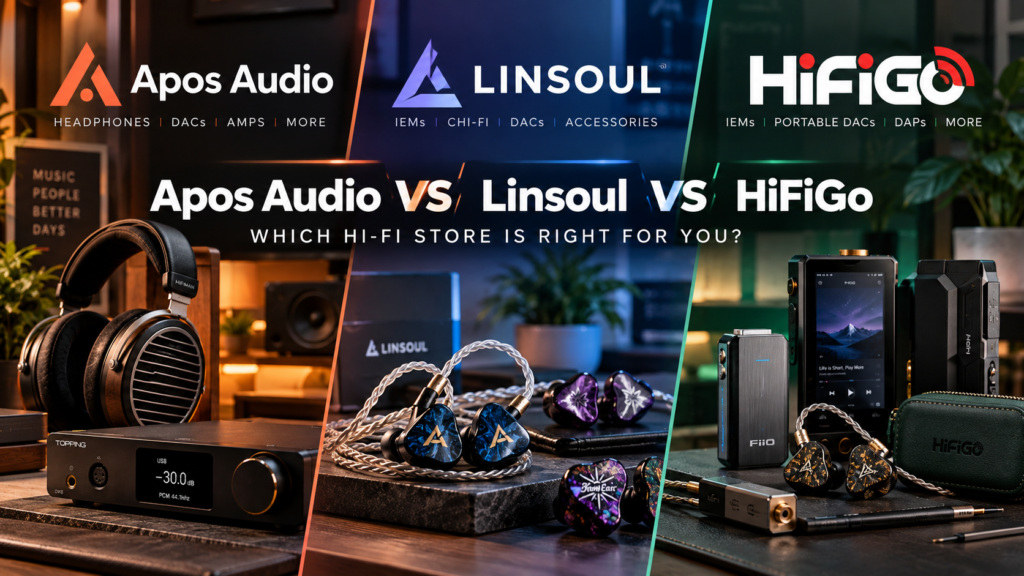
Apos Audio vs Linsoul vs HiFiGo: Which Hi-Fi Store Is Right for You?

Shopping for audiophile gear online can quickly become overwhelming.
You may find the same IEM, headphone, DAC, or amplifier listed by several specialist retailers, often at similar prices. But the buying experience can be very different once you look beyond the product page.
Shipping, returns, warranty support, product selection, geographic location, and after-sales service can matter just as much as the price itself.
Three names that frequently appear when shopping for enthusiast audio gear are Apos Audio, Linsoul Audio, and HiFiGo.
All three serve the audiophile market, but they don’t have exactly the same strengths.
Apos has a particularly broad desktop Hi-Fi catalog covering DACs, headphone amplifiers, tube amps, headphones, IEMs, speakers, turntables, and other components. Linsoul has deep roots in the IEM and Chi-Fi market, while HiFiGo combines a large IEM catalog with portable DACs, amplifiers, players, and other personal-audio equipment.
So which store makes the most sense for your next purchase?
This comparison looks at Apos Audio vs Linsoul vs HiFiGo across product selection, IEMs, headphones, DACs and amplifiers, pricing, shipping, returns, warranty, and customer support.
Rather than declaring one retailer universally better, we’ll focus on which type of shopper each store is better suited to.
Quick Comparison
| Category | Apos Audio | Linsoul Audio | HiFiGo |
|---|---|---|---|
| Main Strength | Desktop Hi-Fi & complete systems | IEMs & Chi-Fi | IEMs & portable Hi-Fi |
| IEM Selection | Very Good | Excellent | Excellent |
| Headphones | Excellent | Good | Good |
| DACs & Amps | Excellent | Very Good | Very Good |
| Tube/Desktop Hi-Fi | Excellent | Moderate | Moderate |
| Budget Chi-Fi | Good | Excellent | Excellent |
| U.S. Buyers | Particularly convenient | International-oriented | International-oriented |
| International Buyers | Available, but potentially costly | Strong global focus | Strong global focus |
| Return Policy | 45 days, conditions apply | Up to 30 days for qualifying products | 30 days for eligible new-condition products |
| Independent Feedback | Mixed, small sample | Mixed | Generally positive on Trustpilot |
| Best Fit | Desktop/headphone systems | IEM enthusiasts | Portable audio & broad Chi-Fi shopping |
The important point is that these aren’t three identical stores with different logos.
Your best starting point depends heavily on what you’re buying and where you live.
What Is Apos Audio?
Apos Audio is a specialist audiophile retailer with a strong focus on desktop and home listening equipment.
Its current catalog includes categories such as:
- DACs
- Headphone amplifiers
- Tube amplifiers
- Speaker amplifiers
- Headphones
- IEMs
- Speakers
- Turntables
- Streamers
- Audio accessories
The current Apos catalog illustrates just how heavily the retailer leans into complete audio systems. Its indexed audio collection includes hundreds of DAC/amp listings alongside substantial headphone, IEM, amplifier, tube, and source categories.
Brands currently represented include names such as FiiO, HIFIMAN, Sennheiser, Audeze, Meze Audio, TOPPING, SMSL, xDuoo, iFi, Focal, Moondrop, Cayin, Burson and others.
That makes Apos particularly relevant if you’re building something like:
Computer → DAC → Headphone Amp → Headphones
rather than simply buying one pair of IEMs.
For a deeper look at its policies and customer experiences, read our Apos Audio Review.
What Is Linsoul Audio?
Linsoul Audio was founded in 2016 by the Crazy HiFi team and describes its mission around serving audiophile and music-listening communities.
Its identity is closely associated with the growth of Chi-Fi and the modern IEM market.
That distinction matters.
Someone looking for an affordable or mid-range IEM may care about a completely different set of products than someone building a $2,000 desktop headphone system.
Linsoul carries:
- IEMs
- Headphones
- DACs
- Amplifiers
- Portable audio products
- Cables
- Ear tips
- Accessories
and products across a wide range of Asian audio brands.
Its catalog is especially interesting for enthusiasts who enjoy exploring different IEM configurations, tuning approaches, and price tiers.
Read our full Linsoul Audio Review for a deeper examination of its shopping experience, warranty, returns, and customer feedback.
What Is HiFiGo?
HiFiGo occupies a similar part of the market to Linsoul, with a strong focus on personal and portable Hi-Fi.
Its homepage currently emphasizes:
IEMs → Portable DACs & Amps → Hi-Fi gear, while its full catalog spans more than a thousand listings across numerous audio categories.
That makes HiFiGo relevant for shoppers interested in:
- IEMs
- Portable DACs
- Dongle DACs
- Headphone amplifiers
- Audio players
- Headphones
- Cables and accessories
- Other enthusiast audio products
It’s therefore broader than simply being an IEM shop, although portable audio remains a major part of its identity.
Our HiFiGo Review looks more closely at the retailer itself.
Apos vs Linsoul vs HiFiGo for IEMs
This is probably the most natural battleground between the three.
And it’s also where Apos becomes somewhat different from the other two.
Linsoul for IEM Shopping
Linsoul is deeply associated with the modern IEM ecosystem.
Its combination of established brands, newer manufacturers, accessories, cables, and frequent new releases makes it particularly useful for shoppers who actively follow the Chi-Fi market.
That can include everything from relatively affordable entry-level IEMs to expensive multi-driver models.
If your shopping process looks like:
“I want to explore lots of IEM brands, driver configurations and price points.”
Linsoul is a logical place to research.
HiFiGo for IEM Shopping
HiFiGo serves a similar audience.
Its current catalog includes brands such as AFUL and many other manufacturers across IEM and portable-audio categories, while the retailer prominently features IEMs as one of its main shopping categories.
It’s particularly useful for shoppers who want to compare IEMs alongside:
portable DACs + dongles + DAPs + accessories.
That creates a natural ecosystem around portable listening.
Apos for IEM Shopping
Apos shouldn’t be ignored for IEMs.
Its catalog includes more than 200 indexed IEM listings in its broader audio collection at the time of our research.
But IEMs are only one part of a much broader desktop and home-audio catalog.
This makes Apos especially interesting when your IEM purchase is part of a larger audio setup rather than the sole focus of your shopping.
Persiavo Take
For shoppers whose primary hobby is exploring IEMs and Chi-Fi, we’d start by comparing Linsoul and HiFiGo’s catalogs.
If your shopping list extends further into headphones, desktop DACs, amplifiers and complete systems, Apos becomes increasingly relevant.
Headphones
The balance changes when we move from IEMs to full-size headphones.
Apos currently lists products from brands including:
- HIFIMAN
- Audeze
- Focal
- Meze Audio
- Sennheiser
- Audio-Technica
- FiiO
- Moondrop
- Noble Audio
among others. Its headphone collection currently shows more than 100 listings, with open-back, closed-back, planar, dynamic, electrostatic and other options represented.
That’s a strong fit for buyers looking at traditional audiophile headphone systems.
Linsoul and HiFiGo also sell headphones, but their broader positioning makes them particularly attractive when headphones overlap with portable audio and the Asian Hi-Fi ecosystem.
What Should You Look For?
Regardless of retailer, don’t choose a headphone based solely on price.
Consider:
Open-back vs closed-back
Driver technology
Comfort
Weight
Impedance and sensitivity
Amplification requirements
Your listening environment
A $1,500 open-back headphone may be a terrible purchase for someone who needs isolation in a shared office.
The retailer matters, but choosing the correct product matters more.
DACs and Amplifiers
This is one of the clearest differences between the retailers.
Apos has a particularly extensive desktop electronics catalog.
Its current categories cover standalone DACs, headphone amplifiers, DAC/amp combinations, tube amplifiers, speaker amplifiers, preamps, op-amps and vacuum tubes.
Its current DAC/amp listings include equipment from manufacturers such as FiiO, TOPPING, HIFIMAN and xDuoo.
That makes Apos especially useful if you’re assembling a desktop stack.
For example:
PC → TOPPING DAC → Tube Amp → HIFIMAN Headphones
Linsoul and HiFiGo also carry DACs and amplifiers.
But their catalogs make particularly good sense when those electronics support an IEM or portable-audio setup.
Think:
Phone → Dongle DAC → IEM
or:
DAP → IEM
rather than exclusively:
Desktop Source → DAC → Preamp → Amp → Headphones/Speakers.
The distinction isn’t absolute, but it helps explain the different shopping experiences.
Portable Audio
For portable listening, the balance shifts toward Linsoul and HiFiGo.
Portable-audio shoppers frequently need more than an IEM.
They may also want:
- Dongle DACs
- Bluetooth DAC/amps
- DAPs
- Replacement cables
- Ear tips
- Cases
- Adapters
HiFiGo prominently organizes its store around IEMs and portable DAC/amps, while Linsoul’s catalog and accessories similarly cater heavily to this audience.
Apos carries portable products too, but its biggest differentiation appears once the system moves onto a desk.
Product Selection: Depth vs Breadth
Simply counting products isn’t enough to decide which retailer has the better catalog.
A store with 500 IEMs isn’t automatically better for someone shopping for a tube amplifier.
The more useful distinction is category depth.
Apos Audio
Particularly deep in:
DACs + headphone amps + headphones + desktop components
Linsoul
Particularly deep in:
IEMs + Chi-Fi + portable-audio accessories
HiFiGo
Particularly deep in:
IEMs + portable DAC/amps + broader portable Hi-Fi
That’s why this comparison doesn’t need a universal product-selection winner.
They’re optimized for somewhat different buying journeys.
Pricing and Deals
Audiophile equipment creates an unusual pricing situation.
Many authorized retailers sell the same model at roughly the same advertised price.
For example, if several retailers carry the same FiiO, Moondrop, HIFIMAN, or other model, the headline price may not differ dramatically.
But the actual purchase cost can.
You need to consider:
Product price
Discount/coupon
Shipping
Import taxes
Return costs
Warranty costs
That last part is frequently ignored.
Saving $30 on a $700 product doesn’t look as attractive if returning it costs substantially more.
So when comparing Apos vs Linsoul vs HiFiGo, don’t compare only the number next to the Add to Cart button.
Compare the total ownership risk as well.
Apos Audio Shipping
Apos has a particularly natural fit for U.S. buyers, but international shipping is available for qualifying products.
For international orders, Apos currently publishes weight-based shipping rates starting at $28 for packages up to one pound and increasing with weight. Products over 20 pounds aren’t eligible under that international shipping schedule. International customers are also responsible for applicable duties and taxes.
This becomes important for large amplifiers and other heavy components.
Apos may make considerable sense for a U.S. shopper while being less attractive to an overseas buyer once international shipping and potential returns are included.
Linsoul Shipping
Linsoul is much more internationally oriented.
Its current shipping policy lists standard carriers including 4PX, Yanwen and YunExpress, with express shipments using carriers including DHL Express, FedEx and SF Express. Customers are responsible for applicable customs, import and processing fees.
Linsoul also advertises worldwide free shipping subject to terms on its product pages.
For international IEM shoppers, this global orientation is one of Linsoul’s major attractions.
HiFiGo Shipping
HiFiGo similarly targets an international customer base.
At the time of our research, its homepage advertised priority free shipping on qualifying $50+ orders for selected destinations including the EU, Japan, Australia and Canada, and express free shipping at $500+.
Shipping promotions and thresholds can change, so check the checkout conditions for your destination before making a decision.
Returns: Read the Fine Print
Return policy may be more important than almost anything else in this comparison.
Audio products are highly personal.
You may dislike an IEM’s tuning.
A headphone may be uncomfortable.
An amplifier may not fit your system.
And a DAC may not offer the connectivity you expected.
Unfortunately, “30-day return policy” and “45-day return policy” don’t necessarily mean free trial.
Apos Returns
Apos currently allows qualifying customers to request an RMA within 45 days of delivery. Products and packaging must meet its like-new requirements.
As covered in our full Apos review, there are important conditions and potential costs later in that window.
For international buyers, the situation is less favorable: Apos states that international customers are responsible for relevant return fees and shipping, including DOA-related shipping under its international-order terms.
Linsoul Returns
Linsoul’s main return-policy page currently states that factory-sealed, non-customized products may be returned within 30 days, with the customer responsible for shipping.
Opened products returned during the first seven days can incur a 35% restocking fee.
Certain products and accessories have additional exclusions, so this is another policy where reading the details before opening a package is worthwhile.
HiFiGo Returns
HiFiGo currently publishes a 30-day return policy for eligible products that remain in brand-new condition.
However, its policy also says that opened products generally aren’t eligible for ordinary change-of-mind refunds after seven days and describes a 30% of MSRP restocking deduction for applicable returns, with an additional packing fee possible if original packaging isn’t complete.
Again:
return window ≠ risk-free trial period.
That’s one of the most important takeaways from comparing specialist international audio retailers.
Warranty
Warranty is particularly important with expensive electronics.
Apos
Apos provides its own warranty framework, including a one-year warranty for qualifying purchases. International orders follow the one-year framework but leave international customers responsible for fees and shipping costs.
Linsoul
Linsoul currently provides one-year warranty coverage for most products, excluding specified accessories, while cables and adapters receive three months. After the initial seven-day period, customers generally pay to send a potentially defective product back for assessment.
HiFiGo
HiFiGo’s published policy separates DOA cases from later warranty handling. Its current policy provides a seven-day DOA guarantee for damaged, incorrect, or unusable products and describes manufacturer/warranty servicing beyond that period depending on the product and circumstances.
For all three stores, check the specific product’s warranty before buying expensive equipment rather than assuming every product receives identical treatment.
Customer Feedback
Published policies tell us what should happen.
Customer feedback helps show what sometimes happens in practice.
But review-platform scores require context.
Apos Audio
At the time of our research, Apos had a 3.9/5 Trustpilot score from only 29 reviews.
The distribution was unusually polarized, with 45% five-star and 45% one-star reviews.
That’s too small and self-selected a sample for us to treat 3.9 as a definitive measurement of Apos’s overall customer experience.
Recent positive reports praise knowledgeable support and successful purchases, while negative experiences discussed in our full Apos review include communication and fulfillment problems.
This is why we characterize Apos’s independent feedback as mixed rather than simply good or bad.
Linsoul
Linsoul has a larger independent review footprint than Apos, but feedback also includes both positive and negative experiences.
As with Apos, we’d use independent reviews to identify recurring issues rather than treating the aggregate score as a direct measure of every future order.
See our Linsoul Audio Review for the full breakdown.
HiFiGo
HiFiGo currently has a notably larger and more positive Trustpilot profile: 4.6/5 from 376 reviews, with 91% rated five stars at the time of our September 2026 check. Trustpilot also notes that the company hasn’t recently invited reviews, while cautioning that reviews may still not represent every customer’s experience.
Recent positive reviews frequently mention responsive support, warranty assistance and international shipping.
There are negative reports too. For example, an April 2026 reviewer complained about a failed cable and refund expectations, while a June reviewer reported an order sitting unresolved until they contacted support about an unavailable color. HiFiGo publicly responded to both complaints.
The larger sample makes this evidence more useful than a handful of anecdotes, but it still shouldn’t be interpreted as a guarantee of an individual order experience.
Customer Support
For expensive Hi-Fi purchases, support matters most when something goes wrong.
Before purchasing, consider asking the retailer a technical question.
For example:
Will this amplifier provide appropriate output for my headphones?
or:
Is this product physically in stock and ready to ship?
The quality and specificity of the response can tell you more than a generic “24/7 support” badge.
It also creates a written record of any compatibility or availability information provided before the order.
U.S. Buyers
For U.S.-based shoppers, Apos has an obvious structural advantage: its corporate base is in Oakland, California, while its catalog is heavily oriented toward desktop audiophile equipment.
That doesn’t mean every Apos order necessarily ships domestically or immediately, so availability should still be checked.
Linsoul and HiFiGo remain relevant, particularly when a specific IEM, portable product, price, or promotion isn’t available domestically.
For a $50 IEM, waiting longer for international fulfillment may be perfectly reasonable.
For a $2,000 amplifier that could require warranty service, the calculation may be very different.
International Buyers
For international shoppers, Linsoul and HiFiGo’s globally oriented operations become more significant.
Both cater heavily to cross-border personal-audio buyers, while Apos publishes explicit international weight-based shipping charges and places international return/warranty shipping responsibilities on the customer.
That doesn’t automatically make Apos unsuitable internationally.
It simply means the total landed cost and potential return cost deserve more attention.
Beginners
Beginners shouldn’t necessarily choose the store with the largest catalog.
In fact, more products can make the decision harder.
Start by deciding what you’re actually trying to buy.
Want your first IEM?
Start by browsing the IEM-focused catalogs at Linsoul and HiFiGo.
Want a complete desktop headphone system?
Apos’s DAC, amplifier and headphone categories provide a natural place to research compatible components.
Want portable Hi-Fi?
Linsoul and HiFiGo are particularly relevant because of their combination of IEMs, portable DACs, DAPs and accessories.
The goal isn’t to choose a retailer first.
Choose the type of system, then choose the retailer.
Experienced Audiophiles
Experienced enthusiasts may actually benefit from using all three.
If you already know the exact model you want, compare:
- Actual final price
- Stock status
- Shipping origin
- Delivery estimate
- Return costs
- Warranty handling
- Current promotion
- Local taxes/duties
Then choose based on the complete transaction rather than store loyalty alone.
This becomes particularly important on high-value purchases.
Apos Audio: Pros & Cons
Pros
✔ Particularly strong desktop Hi-Fi catalog
✔ Excellent selection of DACs and amplifiers
✔ Strong full-size headphone selection
✔ Tube amplification and broader components available
✔ Authorized brands
✔ U.S. presence
✔ Useful for building complete systems
✔ Certified/open-box options
Cons
✘ International shipping can become expensive
✘ International returns/warranty shipping can be costly
✘ Independent customer-feedback sample is relatively small
✘ Customer experiences appear inconsistent
✘ Less IEM-centric than Linsoul or HiFiGo
Linsoul: Pros & Cons
Pros
✔ Excellent IEM focus
✔ Deep Chi-Fi ecosystem
✔ Strong portable-audio selection
✔ Wide international orientation
✔ Large selection across price ranges
✔ DACs, amps and accessories available
✔ One-year warranty on many products
Cons
✘ Return conditions require careful reading
✘ Opened products can face a substantial restocking fee
✘ International warranty returns can involve shipping costs
✘ Import/customs fees may apply depending on destination
HiFiGo: Pros & Cons
Pros
✔ Excellent IEM and portable-audio selection
✔ Large overall catalog
✔ Strong DAC/amp selection
✔ Internationally oriented
✔ Competitive shipping promotions
✔ Much larger Trustpilot sample than Apos
✔ Recent independent feedback is predominantly positive
Cons
✘ Ordinary return conditions are stricter than the headline window may suggest
✘ Restocking deductions may apply
✘ International after-sales service can still require shipping equipment abroad
✘ Some recent complaints involve order processing or product issues
Which Store Fits Which Shopper?
Instead of choosing an overall winner, this is the more useful way to look at the three:
| If You Mainly Want… | Store(s) to Check Closely | Why |
|---|---|---|
| IEMs | Linsoul / HiFiGo | Deep focus on IEM and Chi-Fi ecosystems |
| Budget Chi-Fi | Linsoul / HiFiGo | Broad selection across lower price tiers |
| Portable DACs | HiFiGo / Linsoul | Strong portable-audio ecosystems |
| Full-Size Headphones | Apos + compare others | Strong dedicated headphone catalog |
| Desktop DAC/Amp | Apos | Particularly deep desktop electronics selection |
| Tube Amplifier | Apos | Broader tube/desktop component focus |
| Complete Desktop System | Apos | Headphones, DACs, amps and related components together |
| International IEM Shopping | Linsoul / HiFiGo | Strong cross-border orientation |
| U.S. Desktop Hi-Fi Shopping | Apos | U.S. base plus desktop-focused catalog |
| Exact Known Product | Compare all available sellers | Price, stock and after-sales terms can outweigh general store strengths |
This doesn’t mean the listed retailer will always have the lowest price or best terms for a particular product.
It tells you where it makes sense to start looking.
Frequently Asked Questions
Is Apos Audio legit?
Yes. Apos is an established specialist retailer with a broad catalog covering headphones, IEMs, DACs, amplifiers and other audio equipment. Its current brand and category listings include numerous established audiophile manufacturers.
Is Linsoul legit?
Yes. Linsoul has operated since 2016 and sells a broad selection of audiophile products, with particular strength in IEMs and the Chi-Fi market. It publishes detailed shipping, return and warranty policies.
Is HiFiGo legit?
Yes. HiFiGo is an established specialist audio retailer with a large catalog of IEMs, DACs, amplifiers and other Hi-Fi products. Its Trustpilot profile currently contains hundreds of customer reviews, although—as with any review platform—those reviews shouldn’t be treated as a guarantee of an individual experience.
Which store should I use for IEMs?
Linsoul and HiFiGo are particularly relevant starting points because both stores have a strong focus on IEMs and portable Hi-Fi. Apos also carries a substantial IEM catalog, so comparing all three can still make sense for a specific model.
Should I buy from the cheapest store?
Not automatically.
For audiophile gear, compare the final price together with shipping, duties, return costs, warranty handling and stock status. A small saving can disappear quickly if an international return becomes necessary.
Final Verdict: Apos Audio vs Linsoul vs HiFiGo
There isn’t one retailer that makes the most sense for every audiophile purchase.
The three stores overlap, but each has a noticeably different center of gravity.
| Retailer | Particularly Relevant For | Main Caveat to Check |
|---|---|---|
| Apos Audio | Desktop Hi-Fi, headphones, DACs, amps and complete systems | Fulfillment plus international shipping/return costs |
| Linsoul Audio | IEMs, Chi-Fi and portable audio | Return/restocking and warranty-shipping conditions |
| HiFiGo | IEMs, portable Hi-Fi, DAC/amps and international shopping | Return/restocking conditions and overseas servicing |
Apos Audio makes particular sense to investigate when you’re building a desktop headphone or Hi-Fi system. Its catalog extends deeply into DACs, headphone amplifiers, tube amplifiers, headphones and other components.
Linsoul Audio is especially relevant to shoppers immersed in IEMs and Chi-Fi. Its product ecosystem, accessories and international orientation make it a natural research destination for personal-audio enthusiasts.
HiFiGo occupies similarly strong territory in IEMs and portable Hi-Fi while maintaining a broad catalog of DACs, amplifiers and related products. Its current independent review footprint is also considerably larger than Apos’s, though individual experiences can still vary.
The best way to use this comparison is therefore not to ask:
“Which store is universally better?”
Instead ask:
“Which retailer has the right product, price, shipping arrangement, and after-sales terms for this particular purchase?”
For a $100 IEM, your answer may be Linsoul or HiFiGo.
For a desktop DAC/amp or full-size headphone system in the U.S., Apos may deserve closer attention.
And when the exact same product appears at multiple stores, compare the complete purchase conditions before deciding.
Research Each Store Before Buying
Want a deeper look at the individual retailers before ordering?
Read our Apos Audio Review for its product catalog, returns, warranty and independent customer feedback.
Read our Linsoul Audio Review for a closer look at its IEM selection, shipping, returns and warranty.
Read our HiFiGo Review for its portable-audio catalog and overall shopping experience.
Then check each retailer’s Persiavo Store page for current coupon codes and available promotions before purchasing.
Make Smarter Buying Decisions
Get new reviews, product comparisons, brand discoveries, and practical shopping guides delivered to your inbox.
New Reviews
Shopping Guides
Brand Discoveries