
Epomaker vs NuPhy 2026: Which Mechanical Keyboard Brand Is Better?

Mechanical keyboards have become dramatically better without necessarily becoming dramatically more expensive.
Features that once belonged primarily to enthusiast custom builds — gasket mounting, hot-swappable switches, multi-layer sound dampening, wireless connectivity, PBT keycaps, QMK/VIA support, and even Hall Effect switches — are now available on pre-built keyboards at relatively accessible prices.
Two brands that represent this shift particularly well are Epomaker and NuPhy.
But they approach mechanical keyboards very differently.
Epomaker has built an enormous catalog covering budget-friendly mechanical keyboards, retro-inspired boards, compact layouts, aluminum models, and increasingly capable Hall Effect gaming keyboards.
NuPhy has a smaller and more focused ecosystem, with particular strength in premium low-profile keyboards such as the Air series and refined high-profile models such as the Halo series.
So which one should you buy?
In this Epomaker vs NuPhy comparison, we’ll compare typing experience, build quality, gaming performance, wireless connectivity, software, design, portability, product selection, pricing, and overall value to determine which keyboard brand makes more sense in 2026.
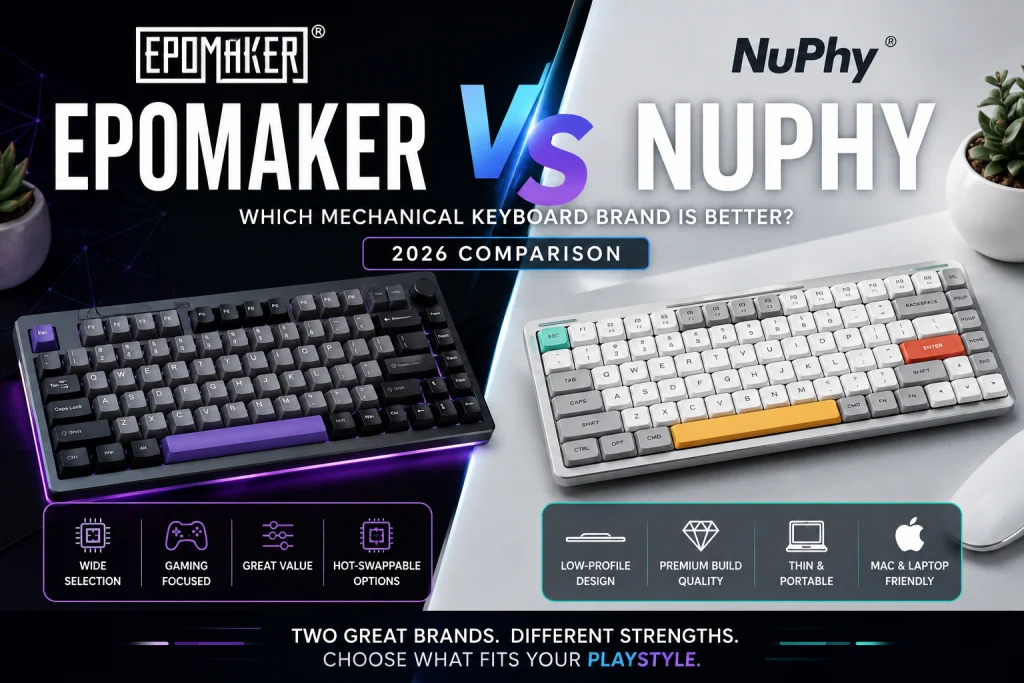
Quick Verdict: Epomaker vs NuPhy
If you don’t want to read the entire comparison, here’s the short answer:
Choose Epomaker if you want maximum features and customization for your money.
Choose NuPhy if you want a more refined, cohesive keyboard experience — particularly if you’re interested in low-profile keyboards.
| Category | Epomaker | NuPhy | Winner |
|---|---|---|---|
| Product Selection | ⭐⭐⭐⭐⭐ | ⭐⭐⭐⭐☆ | Epomaker |
| Typing Experience | ⭐⭐⭐⭐½ | ⭐⭐⭐⭐½ | Tie |
| Build & Design | ⭐⭐⭐⭐☆ | ⭐⭐⭐⭐⭐ | NuPhy |
| Low-Profile Keyboards | ⭐⭐⭐☆☆ | ⭐⭐⭐⭐⭐ | NuPhy |
| Gaming Features | ⭐⭐⭐⭐⭐ | ⭐⭐⭐⭐☆ | Epomaker |
| Software & Customization | ⭐⭐⭐½☆ | ⭐⭐⭐⭐☆ | NuPhy |
| Portability | ⭐⭐⭐⭐☆ | ⭐⭐⭐⭐⭐ | NuPhy |
| Value for Money | ⭐⭐⭐⭐⭐ | ⭐⭐⭐⭐☆ | Epomaker |
| Beginner Friendliness | ⭐⭐⭐⭐½ | ⭐⭐⭐⭐½ | Tie |
| Overall | 4.4/5 | 4.5/5 | NuPhy by a narrow margin |
There isn’t a universal winner here.
Epomaker wins on variety, aggressive pricing, gaming options, and feature-per-dollar value.
NuPhy wins on product focus, industrial design, portability, and the overall polish of its low-profile ecosystem.
For most productivity users and Mac owners who want a premium low-profile keyboard, we’d lean toward NuPhy.
For gamers, first-time mechanical-keyboard buyers, and enthusiasts trying to maximize features without spending too much, Epomaker can be the better deal.
Epomaker vs NuPhy: The Biggest Difference
The easiest way to understand these two brands is through their product philosophy.
Epomaker: More Choices, More Features, More Price Points
Epomaker’s catalog is huge.
Its current families include traditional mechanical keyboards, retro-inspired RT models, TH keyboards focused on typing sound and value, and an increasingly extensive HE series built around Hall Effect switches.
For example, the current HE lineup ranges from the compact HE30 through models such as the HE68 Lite, HE75 V2, HE80, G84 HE and full-size HE108. Epomaker advertises features such as adjustable actuation, Rapid Trigger and polling rates up to 8000Hz on several of these gaming-focused boards.
Its TH family takes a different approach, emphasizing gasket mounting, factory tuning, hot-swappable switches and satisfying acoustics. Current TH models span 75%, TKL, 96% and full-size layouts.
That breadth is one of Epomaker’s biggest advantages.
NuPhy: A More Focused Ecosystem
NuPhy’s catalog feels more curated.
Its most recognizable products are the Air keyboards, which focus heavily on low-profile mechanical typing.
The current Air V3 family offers multiple layouts, a thin 13.2mm chassis, 4,000mAh battery, wireless connectivity and updated low-profile switches. NuPhy also offers higher-profile models such as the Halo series and other designs including Kick75 and Node.
This creates the first major distinction:
Epomaker feels like a keyboard marketplace built around variety.
NuPhy feels more like a focused keyboard brand built around specific design philosophies.
Neither approach is inherently better.
It depends on what you’re shopping for.
Product Selection: Epomaker Wins
If sheer choice matters, Epomaker wins easily.
You can find keyboards targeting:
- First-time mechanical-keyboard users
- Office workers
- Programmers
- Competitive gamers
- Retro-design enthusiasts
- RGB-focused setups
- Full-size productivity
- Compact desk setups
- Hall Effect gaming
- Wireless use
- Sound-focused enthusiasts
The current TH lineup alone runs from 75% through full-size boards, while the HE lineup offers Hall Effect options from extremely compact layouts through 108-key designs.
Then there’s the RT family.
Models such as the RT75, RT82, RT85, RT98 and RT100 Pro combine retro styling with unusual features such as displays, knobs and even joystick controls depending on the model.
NuPhy still provides meaningful variety, but its lineup is much easier to understand.
That can actually be an advantage for beginners.
Winner: Epomaker
If you enjoy comparing dozens of layouts, switches and configurations, Epomaker gives you considerably more to explore.
Want a deeper look at the brand before deciding? Read our Epomaker Review 2026 for our full assessment of its keyboards, software, quality and value.
Design & Build Quality: NuPhy Wins
This is where NuPhy starts pulling ahead.
NuPhy puts considerable emphasis on industrial design.
The Air V3 series, for example, uses a CNC-machined case with an anodized finish while keeping the chassis as thin as 13.2mm.
The result is a keyboard that feels intentionally designed rather than simply assembled around a feature checklist.
NuPhy’s visual identity is also unusually consistent.
You can generally recognize an Air-series keyboard without seeing the logo.
Epomaker’s design language is much broader.
That’s partly because Epomaker sells and collaborates across such a large range of products.
Some boards look minimalist.
Others are retro.
Some emphasize RGB.
Others feature screens, knobs or unconventional colorways.
That gives you more freedom, but less brand-level consistency.
Winner: NuPhy
For cohesive industrial design and a premium aesthetic, NuPhy gets our vote.
For maximum visual variety, Epomaker still has the advantage.
Typing Experience: Too Close to Call
This category is more complicated because typing feel depends heavily on:
- Switches
- Keycaps
- Mounting system
- Case materials
- Internal dampening
- Layout
- Personal preference
Epomaker has become particularly aggressive about delivering good acoustics at affordable prices.
Its TH series emphasizes multi-layer dampening, gasket mounting and factory-lubed switches, with the explicit goal of producing a satisfying sound without requiring users to modify the keyboard themselves.
The RT series similarly uses features such as pre-lubed switches, PBT keycaps and hot-swappable PCBs on applicable models.
NuPhy takes a more controlled approach.
Its keyboards often feel more cohesive out of the box, while buyers can still choose between different switch options.
For example, the Air75 V3 currently offers several low-profile Nano switches, while NuPhy has redesigned the Air V3 series around deeper switch travel than earlier generations.
Winner: Tie
If you want a traditional mechanical keyboard with a deep, creamy or “thocky” sound, we’d lean toward the right Epomaker model.
If you prefer a refined low-profile typing experience, we’d choose NuPhy.
Low-Profile Keyboards: NuPhy Wins Easily
This is one category where the comparison isn’t particularly close.
NuPhy has made low-profile keyboards a core part of its identity.
The Air series is specifically designed around thin mechanical keyboards that work well for portable setups, laptops, MacBooks and minimalist desks.
The current Air75 V3 is a 75% wireless mechanical keyboard priced at $139.95 at the time of our research, while the Air V3 family is available across several layouts.
Its predecessor, the Air75 V2, already offered:
- 1000Hz polling
- 2.4GHz wireless
- Bluetooth
- USB-C
- Windows compatibility
- macOS compatibility
- Linux compatibility
- QMK/VIA customization
Epomaker does sell low-profile keyboards, but the category isn’t as central to the brand.
Winner: NuPhy
If your search begins with:
“I want a premium low-profile mechanical keyboard”
we’d start with NuPhy.
Gaming: Epomaker Wins
This category has changed significantly.
Epomaker is no longer simply a budget mechanical-keyboard brand.
Its Hall Effect lineup is now clearly aimed at competitive gaming.
The HE68 Lite, for example, offers Hall Effect switches, 0.01mm adjustable actuation and 8000Hz polling, while the HE80 advertises 0.02mm adjustable Rapid Trigger and 8000Hz wired polling. The HE75 V2 and HE108 push the adjustable-actuation approach further.
Features such as:
- Rapid Trigger
- Adjustable actuation
- Hall Effect switches
- High polling rates
- SOCD
- DKS
give Epomaker considerably more gaming-focused options.
NuPhy keyboards can absolutely be used for gaming.
Models such as the Halo IO series provide 1000Hz polling and tri-mode connectivity.
But if competitive gaming is the primary buying criterion, Epomaker currently gives shoppers more specialized options.
Winner: Epomaker
For everyday gaming, either brand works.
For shoppers specifically looking for Hall Effect and Rapid Trigger features, Epomaker has the stronger lineup.
Wireless Connectivity: Very Close
Both brands have embraced wireless keyboards.
Depending on the model, you’ll commonly find combinations of:
2.4GHz + Bluetooth + wired USB-C
NuPhy’s Air75 V2 and Halo IO products both support tri-mode connectivity.
Epomaker similarly offers tri-mode wireless across many current keyboards, including products in its RT and broader mechanical-keyboard catalog.
For normal productivity and casual gaming, either ecosystem can work well.
Winner: Tie
Check the exact model rather than choosing purely by brand.
Software & Customization: NuPhy Has a Small Advantage
This has historically been one of the more complicated parts of the Epomaker experience.
Epomaker hardware often offers excellent value, but the software experience can vary between models.
Some products use proprietary software.
Others support VIA or QMK/VIA.
That makes the experience less consistent across the catalog.
Persiavo’s broader Epomaker review identified software consistency as one of the brand’s main weaknesses alongside customer support and quality-control variation.
NuPhy isn’t completely uniform either, but several of its keyboards support QMK/VIA, and NuPhy maintains configuration resources for products such as the Air75 V2, Air96 V2, Gem80, Halo75 V2, Halo96 V2 and Kick75.
The newer Air V3 family also integrates NuPhyIO 2.0.
Winner: NuPhy
Not by a huge margin, but its ecosystem feels somewhat easier to understand.
If advanced remapping is important, always check the specific keyboard’s software support before buying.
Portability: NuPhy Wins
A keyboard doesn’t need to be portable for everyone.
But if you move between:
- Home
- Office
- University
- Coworking spaces
- Travel setups
then keyboard thickness and weight matter.
This is exactly where NuPhy’s Air lineup shines.
At just 13.2mm thin in the Air V3 family, NuPhy has clearly designed these keyboards with portability in mind.
Pair an Air75 with a laptop and you can create a mechanical-keyboard setup without carrying a bulky full-height board.
Epomaker has plenty of compact keyboards, but compact isn’t necessarily the same as low-profile.
Winner: NuPhy
For a permanent desktop setup, this advantage matters much less.
Battery Life: Compare the Specific Models
We wouldn’t declare one universal winner here.
Battery capacity and runtime vary dramatically between individual keyboards.
NuPhy’s current Air V3 generation uses a 4,000mAh battery and claims substantial battery improvements over previous generations.
Epomaker, meanwhile, has models with very large batteries.
The TH80 V2 Pro, for example, currently advertises a 10,000mAh battery, while the RT100 Pro uses a 5,000mAh battery.
Battery capacity alone also doesn’t determine actual runtime.
RGB brightness, wireless mode, firmware and usage patterns all matter.
Winner: Tie
Compare the exact keyboards you’re considering.
Mac Users: NuPhy Has the Edge
Both brands offer keyboards compatible with macOS.
But NuPhy has made Mac compatibility and laptop-oriented design particularly central to products such as the Air series.
The Air V3 product page even positions the lineup directly around Mac and iPad use.
The low-profile design also pairs naturally with MacBook setups.
That doesn’t mean Epomaker is a poor choice for Mac users.
Many Epomaker keyboards support both Windows and Mac.
But if you’re building a clean Mac-focused desk setup, NuPhy feels more purpose-built for that use case.
Winner: NuPhy
Value for Money: Epomaker Wins
This may be Epomaker’s biggest advantage.
Consider its current Hall Effect lineup.
At the time of our research:
- HE68 Lite — $49.99
- HE80 — $69.99
- G84 HE — $84.99
- HE75 V2 TMR — $129
- HE108 — from $95.99
Its conventional TH series is similarly aggressive, with the TH80 V2 starting around $68.99 and several larger models remaining below $100 at current listed prices.
NuPhy generally sits higher.
For example, the Air75 V3 is currently listed at $139.95, while the Halo96 V2 is also around the $139.95 level before applicable discounts.
You’re not necessarily overpaying for NuPhy.
Part of the additional cost goes toward its more cohesive design, materials and product positioning.
But if the question is:
“How many features can I get for my money?”
Winner: Epomaker
This is one of the strongest reasons to choose the brand.
Want maximum keyboard features without premium pricing? Check the latest Epomaker keyboards and current offers →
Affiliate CTA: link this sentence directly to your Epomaker affiliate URL.
Epomaker vs NuPhy for Beginners
This is surprisingly close.
Choose Epomaker as Your First Mechanical Keyboard If:
You want to experiment.
Epomaker makes it easy to explore:
- Different layouts
- Different switches
- Hot-swapping
- Gasket mounts
- RGB
- Wireless
- Different sound profiles
without necessarily making a huge investment.
Its TH series is explicitly positioned around beginner-friendly, good-sounding keyboards.
Choose NuPhy as Your First Mechanical Keyboard If:
You want fewer decisions.
Pick the size.
Pick the switches.
Pick the color.
Start typing.
NuPhy’s smaller, more coherent lineup can actually be less intimidating.
Winner: Tie
Epomaker is better for exploration.
NuPhy is better for simplicity and refinement.
Epomaker vs NuPhy for Work
For a permanent office desk, either brand can work.
But our preference depends on the type of work.
Coding
Either.
Prioritize layout and programmability.
Writing
NuPhy has a slight edge if you prefer a clean, refined typing experience.
Epomaker can be better if you specifically want a deeper traditional mechanical sound.
Excel & Data Work
Don’t blindly buy a 75% keyboard.
Look at larger layouts with a numpad.
Epomaker offers multiple 96% and full-size options in families such as TH and RT.
NuPhy also offers larger layouts, including Air and Halo variants.
Working With a Laptop
NuPhy wins.
The Air series is simply better suited to portable laptop setups.
Epomaker vs NuPhy for Gaming
If gaming is secondary to productivity:
Either brand.
If gaming is your primary reason for buying:
Epomaker.
The Hall Effect lineup changes the comparison.
Rapid Trigger and adjustable actuation can matter in competitive games where repeated movement inputs and precise actuation are important.
That doesn’t automatically make you a better player.
But it gives Epomaker hardware specifically designed around competitive input behavior.
For casual gaming, we wouldn’t choose based on 8000Hz polling alone.
Comfort, switches, layout and overall typing experience may matter more.
Epomaker vs NuPhy: Which Has Better Keyboards?
That’s not quite the right question.
The better question is:
Which brand makes the better keyboard for your specific use?
Here’s our recommendation:
| Your Priority | Pick |
|---|---|
| Best budget value | Epomaker |
| Best low-profile keyboard | NuPhy |
| Competitive gaming | Epomaker |
| Hall Effect switches | Epomaker |
| MacBook setup | NuPhy |
| Portable productivity | NuPhy |
| Maximum model selection | Epomaker |
| Premium industrial design | NuPhy |
| Traditional mechanical feel on a budget | Epomaker |
| First mechanical keyboard | Either |
| Customization & experimenting | Epomaker |
| Simple premium setup | NuPhy |
Which Epomaker Keyboard Should You Buy?
For most buyers, we’d narrow Epomaker down by use case rather than trying to compare its entire catalog.
For Beginners: TH80 Series
A compact 75% layout, gasket mounting, hot-swapping and relatively accessible pricing make the TH family a sensible introduction to mechanical keyboards.
For Gaming: HE75 V2 or HE80
These provide Hall Effect technology and adjustable actuation without immediately pushing into ultra-premium gaming-keyboard pricing.
For Retro Style: RT Series
If design matters as much as functionality, the RT family offers some of Epomaker’s most distinctive boards.
For a deeper assessment before buying, see our full Epomaker Review.
Which NuPhy Keyboard Should You Buy?
NuPhy’s decision tree is simpler.
For Most Users: Air75 V3
The 75% layout provides a strong balance between compact size and everyday functionality.
It’s particularly attractive for laptop users, Mac owners and people who move their keyboard between locations.
For More Keys: Air100 V3
If you want the Air experience but rely on a larger layout, move up within the Air V3 family.
For a Traditional High-Profile Keyboard: Halo Series
The Halo line is the better direction if you like NuPhy’s design philosophy but don’t want low-profile switches.
Want our full assessment before choosing? Read our NuPhy Review 2026 →
Internal link this anchor to your existing NuPhy Review.
Is NuPhy Worth Paying More Than Epomaker?
Sometimes.
If you’re comparing only specifications, Epomaker often looks better.
You may get:
- More features
- Larger batteries
- More layout choices
- Hall Effect technology
- Rapid Trigger
- Screens or knobs
for less money.
But keyboards aren’t just specification sheets.
You’re touching the product for hours every day.
NuPhy’s advantages tend to appear in areas that are harder to express with one number:
- Industrial design
- Portability
- Product cohesion
- Low-profile specialization
- Overall refinement
If those qualities matter, the premium can be justified.
If you’re primarily chasing maximum functionality per dollar, Epomaker is harder to beat.
Should You Buy Directly From Epomaker or NuPhy?
Price shouldn’t be the only consideration.
Before purchasing, compare:
- Current discounts
- Shipping cost
- Delivery estimate
- Warranty
- Return policy
- Payment protection
Persiavo readers should also check current offers before paying full price.
Found the Epomaker you want? Shop Epomaker →
Affiliate link.
Prefer NuPhy’s low-profile and premium design? Shop NuPhy →
Affiliate link.
These are good places for direct affiliate CTAs because the reader has already reached a high-intent buying section.
Pros & Cons
Epomaker Pros
✔ Excellent feature-to-price ratio
✔ Huge keyboard selection
✔ Strong budget options
✔ Excellent Hall Effect selection
✔ Many hot-swappable keyboards
✔ Numerous layouts
✔ Good out-of-box acoustics on many models
✔ Interesting retro and enthusiast designs
Epomaker Cons
✘ Product lineup can be overwhelming
✘ Software varies between models
✘ Quality-control consistency can vary
✘ Overall ecosystem feels less cohesive
NuPhy Pros
✔ Excellent industrial design
✔ Outstanding low-profile lineup
✔ Strong Mac/laptop pairing
✔ Good portability
✔ Refined typing experience
✔ Attractive cohesive aesthetic
✔ QMK/VIA available on several models
✔ Easier product lineup to understand
NuPhy Cons
✘ Generally more expensive
✘ Fewer models
✘ Less choice at the budget end
✘ Fewer dedicated Hall Effect gaming options
Frequently Asked Questions
Is Epomaker better than NuPhy?
Epomaker is generally better for value, product variety and gaming-focused features, while NuPhy is stronger for low-profile keyboards, portability and industrial design. Neither brand is universally better.
Is NuPhy worth the extra money?
It can be. NuPhy’s premium makes the most sense if you value its low-profile design, portability and more cohesive product experience. If maximum features per dollar matter more, Epomaker often provides better value.
Is Epomaker or NuPhy better for gaming?
We’d choose Epomaker for competitive gaming because its current HE lineup offers Hall Effect switches, Rapid Trigger, adjustable actuation and high polling rates across multiple price points.
Is Epomaker or NuPhy better for Mac?
Both support macOS on applicable models, but we’d give NuPhy the advantage. The Air series is particularly well suited to MacBook and portable productivity setups.
Which brand is better for a first mechanical keyboard?
Both are good choices. Choose Epomaker if you want to experiment with layouts, switches and customization at a lower price. Choose NuPhy if you’d rather have a more focused, refined out-of-box experience.
Final Verdict: Epomaker vs NuPhy
| Category | Epomaker | NuPhy | Winner |
|---|---|---|---|
| Product Selection | 4.9/5 | 4.3/5 | Epomaker |
| Typing Experience | 4.5/5 | 4.6/5 | NuPhy |
| Build & Design | 4.2/5 | 4.7/5 | NuPhy |
| Low-Profile | 3.5/5 | 4.9/5 | NuPhy |
| Gaming | 4.8/5 | 4.1/5 | Epomaker |
| Software | 3.7/5 | 4.2/5 | NuPhy |
| Portability | 4.1/5 | 4.8/5 | NuPhy |
| Value | 4.8/5 | 4.2/5 | Epomaker |
| Overall | 4.4/5 | 4.5/5 | NuPhy |
Our Winner: NuPhy — But Only by a Narrow Margin
NuPhy wins our overall comparison, but this isn’t a situation where we’d simply tell everyone to buy NuPhy.
The two brands excel in different areas.
Choose Epomaker if you want:
Maximum value, Hall Effect gaming features, lots of layouts, extensive customization options, or a traditional mechanical keyboard without spending too much.
Choose NuPhy if you want:
A premium low-profile keyboard, excellent portability, a Mac-friendly setup, cohesive industrial design, or a more refined overall product experience.
For gamers, we’d personally choose Epomaker.
For portable productivity, we’d choose NuPhy.
For first-time buyers on a tighter budget, Epomaker has the edge.
For someone who wants one polished keyboard for years of everyday work, NuPhy gets our vote.
Before making the final decision, read our Epomaker Review and NuPhy Review for a deeper look at each brand individually.
Then, when you’re ready to buy:
Make Smarter Buying Decisions
Get new reviews, product comparisons, brand discoveries, and practical shopping guides delivered to your inbox.
New Reviews
Shopping Guides
Brand Discoveries